
iCare
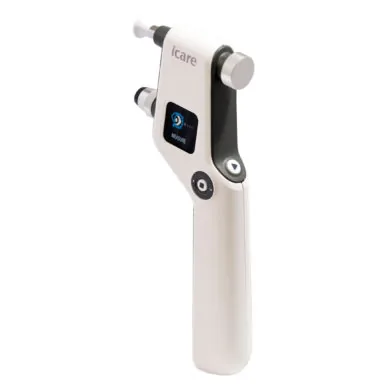
iCare IC100
Handheld rebound tonometer for measuring intraocular pressure in seated or standing patients without anesthetic drops, air, or calibration.
Overview
The IC100 uses iCare's rebound measuring principle: a lightweight single-use probe contacts the cornea briefly, and iCare describes the measurement as painless and hygienic without local anesthetic. An advanced positioning assistant shows a red or green light at the probe base to confirm alignment, and iCare states the instrument requires only minimal training. It suits routine exams, screening days, and workflows where speed and patient comfort matter.
Key capabilities
Rebound measurement with no anesthetic drops, no air puff, and no calibration
Single or rapid six-measurement series from one button
Positioning assistant with red and green alignment lights at the probe base
Single-use iCare TP01 probes, individually packed to prevent cross-contamination
Fully portable and battery powered for use anywhere in the office
Suitable across ages, including younger and non-compliant patients, per iCare
Technical specifications
Figures below come from current iCare product material. Confirm configuration-specific details with us before purchase.
| Measurement principle | Rebound tonometry |
|---|---|
| Measurement range | 7 to 50 mmHg |
| Accuracy (95% tolerance vs manometry) | ±1.2 mmHg at 20 mmHg and below, ±2.2 mmHg above 20 mmHg |
| Repeatability | Less than 8% |
| Patient position | Sitting or standing |
| Weight | 135 g without batteries, 230 g with 4 AA batteries |
| Dimensions | 29 x 95 x 215 mm |
| Probes | Single-use iCare TP01 |
Why rebound tonometry changes the exam
Applanation requires anesthetic drops and a skilled operator. Some patients dislike air-puff testing. Rebound tonometry avoids the air puff and does not require anesthetic drops, and iCare states the IC100 requires only minimal training, so more of your team can take a reading. That widens who can measure IOP in your office and when.
Who this is a good fit for
If none of these describe your practice, it is probably not the right choice, and we will tell you that.
Practices moving away from air-puff or applanation tonometry
High-volume screening where technicians take most measurements
Pediatric and anxious patients, where avoiding drops and air puff helps
Offices that want a portable tonometer that moves between lanes
What to ask on a demo
A demo is worth more when you arrive with your own cases and a list of questions. Here is what we would raise.
- Have your technicians take a few readings and compare them against your current method
- Ask about per-measurement probe cost and how probes are ordered
- Try the positioning lights with a staff member who has never used one
- Compare it side by side with the IC200 if you also see patients supine
How Blue River Medical supports the iCare IC100
Equipment consultation and model selection
On-site or in-office demo
Installation coordination
Staff training
Workflow planning around your existing lane
Ongoing customer support and service coordination
Trade-in discussions when you are replacing equipment
We serve eye care practices across Colorado, Arizona, New Mexico, Wyoming, and Utah. Service and repair responsibility differs by manufacturer and model, so ask us what we handle directly and what we coordinate with the manufacturer. See service and maintenance for our general equipment service capabilities.
For the manufacturer's own material, see the official iCare product page.
Related products
iCare
iCare IC200
iCare's most versatile rebound tonometer, measuring intraocular pressure with the patient sitting, standing, elevated, reclined, or fully supine.
Learn moreiCare
iCare COMPASS
Fundus-guided automated perimeter that runs standard 24-2, 30-2, and 10-2 visual fields with real-time retinal tracking while capturing TrueColor confocal fundus images in the same session.
Learn moreiCare
iCare MAIA
Confocal microperimeter that maps macular sensitivity, analyzes fixation, and images the retina in one exam, for detecting and monitoring macular disease.
Learn moreRequest Information
Ask about iCare IC100 pricing, schedule a demo, or start a trade-in conversation. We will come back with specifics for your practice.
Prefer to call? We are here to help.
Call Us: (877) 707-5688