
Optovue
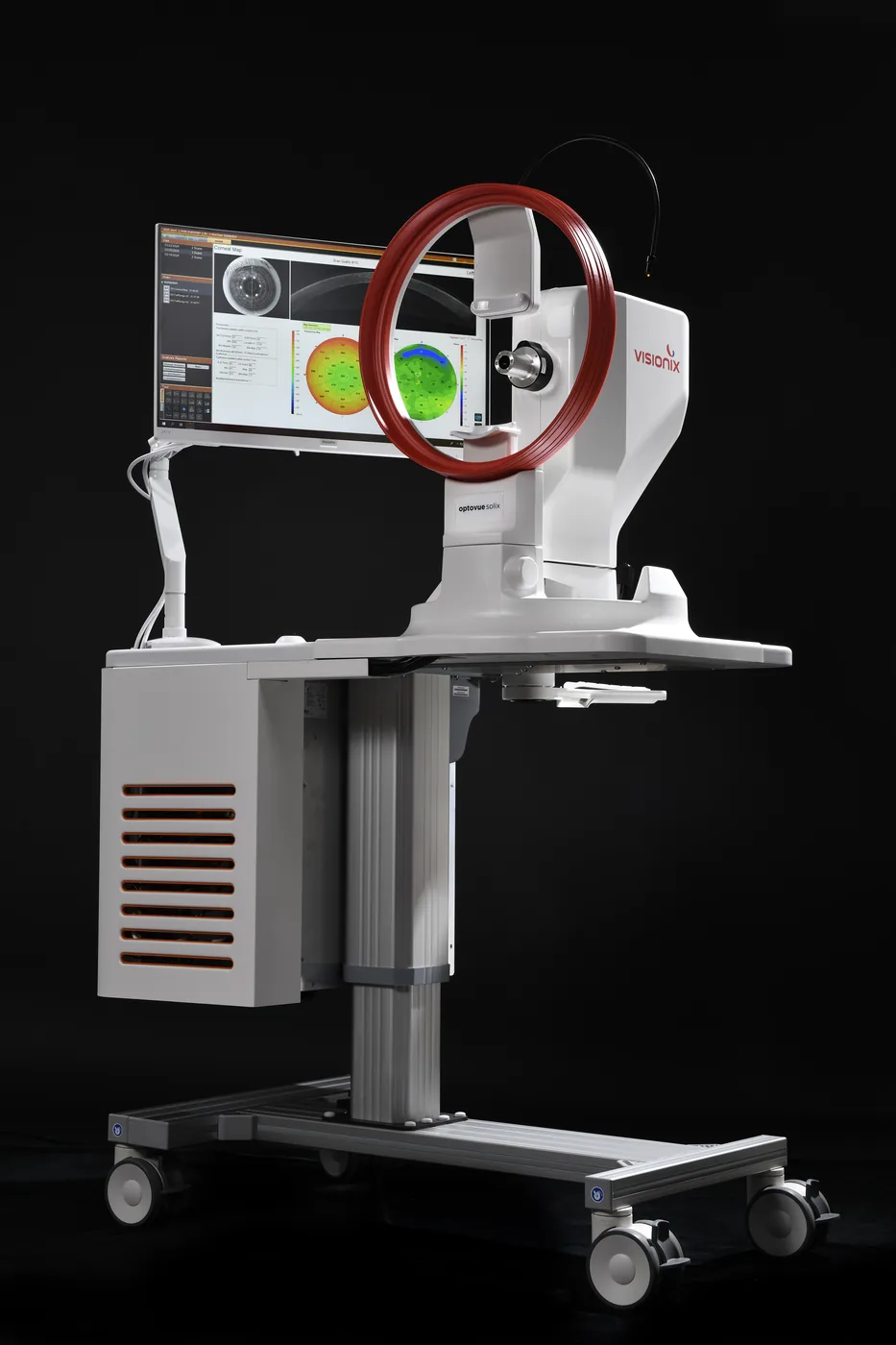
Optovue SOLIX
FullRange spectral domain OCT and OCT-A with a 120 kHz scan speed, integrated fundus camera, and AngioVue angiography.
Overview
SOLIX is Optovue's flagship platform and a strong option for practices evaluating replacement of an older OCT. It runs spectral domain OCT at a 120 kHz scan speed with 5 micron axial and 15 micron transverse resolution, and it pairs that with AngioVue OCT angiography so structural and vascular imaging come from the same capture. FullRange is the scan range that makes the long posterior and anterior scans below possible on one instrument, in a single acquisition.
Technical highlights
Key capabilities
FullRange Retina scan at 16 x 6.25 mm, wide enough to include the vitreous and to image highly myopic eyes
FullRange Anterior scan at 18 x 6.25 mm covering the anterior chamber or the crystalline lens
AngioVue OCT-A for non-invasive visualization and quantification of retinal vasculature
AngioVue QuadMontage, which combines four 9 x 9 mm scans into a widefield view of the peripheral retina
Single-scan glaucoma protocol reporting optic nerve head parameters, RNFL and GCC thickness against a normative reference database
Radial peripapillary capillary vasculature and RPC density
Pachymetry, epithelial trend, angle measurement, and external color imaging
Integrated fundus camera and external IR imaging
iWellness scan for routine comprehensive assessment
DualTrac Motion Correction Technology, multi-volume averaging SSADA, 3D PAR 2.0, and AI segmentation
Topography module available on the platform
OCT and OCT-A on one capture
Structural OCT tells you where tissue is and how thick it is. OCT angiography shows perfusion without a dye injection. On SOLIX the AngioVue single scan produces structural and vascular OCT together, so a technician is not running two acquisitions and you are not comparing images taken minutes apart. For a practice that currently refers out for OCT-A or has no OCT-A capability in-house, this is often the capability that changes the workflow most. OCT-A and fluorescein angiography answer different questions, so this is an addition to your imaging, not a replacement for FA.
Posterior segment
The FullRange Retina scan runs 16 x 6.25 mm. The extra depth matters in two common situations: eyes with significant vitreous pathology, and high myopes whose posterior pole falls outside the range of a conventional SD-OCT scan. AngioVue QuadMontage stitches four 9 x 9 mm scans for a widefield look at the peripheral retina.
Anterior segment
The FullRange Anterior scan runs 18 x 6.25 mm and covers the entire anterior chamber or the crystalline lens in one pass, alongside pachymetry and angle measurement. Epithelial trend and external color imaging come from the same device, so corneal and contact lens work does not need a separate instrument.
Glaucoma imaging and analytics
A single scan protocol returns optic nerve head parameters, RNFL and GCC thickness compared against a normative reference database, and radial peripapillary capillary density. DualTrac motion correction, SSADA multi-volume averaging, and AI segmentation work together to improve repeatability, which is the property that actually matters when you are tracking change across visits rather than reading a single scan.
Workflow and technician considerations
Scan speed shows up as chair time. A faster acquisition means fewer repeats on patients who blink or cannot hold fixation, which is where most OCT delays come from in a busy pre-test lane. Worth walking through on a demo: who runs the instrument in your office, how the protocols are assigned, and how images reach your EMR.
How SOLIX differs from SOLIX Essential
The two platforms share the same engine and most of the software. Both run at 120 kHz with the same 5 micron axial and 15 micron transverse resolution, and both include iWellness, AngioVue single scan, AngioVue OCT-A with enhanced metrics, multi-volume averaging SSADA, 3D PAR 2.0, and DualTrac motion correction. Both also image the anterior segment, including pachymetry, angle measurement and corneal layer mapping, so Essential is not the posterior-only option. What the fully featured SOLIX adds is FullRange scan range on both the 16 x 6.25 mm posterior and 18 x 6.25 mm anterior scans, integrated fundus photography, external IR imaging, and the wider multimodal option set. The question to answer is whether you need that scan range and multimodality, not whether you need corneal imaging.
Replacing an older OCT?
If your current OCT predates angiography, or you are maintaining a platform the manufacturer no longer supports, it is worth a conversation before you start pricing. We can look at what you image today, what you refer out, how your pre-test lane is staffed, and whether SOLIX or SOLIX Essential fits. Trade-in of existing equipment is something we can discuss as part of that. We do not quote a trade-in figure before seeing what you have.
Who this is a good fit for
If none of these describe your practice, it is probably not the right instrument, and we will tell you that.
Practices replacing a first or second generation OCT that cannot do angiography
Glaucoma-heavy practices that want structural and vascular data from one scan protocol
Retina-focused clinics that need widefield OCT-A without injecting dye
Offices seeing high myopes, where a standard scan depth clips the image
Practices that want anterior segment and pachymetry on the same instrument as their retina imaging
What to ask on a demo
A demo is worth more when you arrive with your own cases and a list of questions. Here is what we would raise.
- Bring the scan types you run most often and compare capture time against your current OCT
- Ask to see a FullRange scan on a high myope if you see many
- Look at the glaucoma single-scan report and how it presents change over time
- Walk through EMR integration and where images land
- Discuss who in your office will operate it and what training looks like
- Ask about the topography module if anterior segment work matters to you
How Blue River Medical supports the Optovue SOLIX
Equipment consultation and model selection
On-site or in-office demo
Installation coordination
Staff training
Workflow planning around your existing lane
Ongoing customer support and service coordination
Trade-in discussions when you are replacing equipment
We serve eye care practices across Colorado, Arizona, New Mexico, Wyoming, and Utah. Service and repair responsibility differs by manufacturer and model, so ask us what we handle directly and what we coordinate with the manufacturer. See service and maintenance for our general equipment service capabilities.
Other Visionix and Optovue systems
Optovue
Optovue SOLIX Essential
The same 120 kHz SOLIX engine and AngioVue OCT-A in a configuration without FullRange imaging and the multimodal additions.
Learn moreOptovue
Optovue iVue 80
Compact 80 kHz spectral domain OCT with slit-lamp style operation, covering retina, optic disc, and cornea from one technician-friendly console.
Learn moreOptovue
Optovue iFusion 80
The iVue 80 OCT combined with the 12 megapixel iCam 12 fundus camera in one space-saving imaging system.
Learn moreRequest Information
Ask about Optovue SOLIX pricing, schedule a demo, or start a trade-in conversation. We will come back with specifics for your practice.
Prefer to call? We are here to help.
Call Us: (877) 707-5688