Optovue
Optovue SOLIX Essential
The same 120 kHz SOLIX engine and AngioVue OCT-A in a configuration without FullRange imaging and the multimodal additions.
Overview
SOLIX Essential is the same spectral domain platform as SOLIX, configured for practices that do not need FullRange imaging or the multimodal additions. It runs at the same 120 kHz scan speed with the same 5 micron axial and 15 micron transverse resolution, and it includes the proprietary Optovue scans and software with advanced scan patterns. Anterior segment work is well covered: Visionix lists corneal scans with pachymetry, angle measurement and 3D imaging, plus a 10 mm Corneal Layer Map across 16 meridians quantifying epithelial, stromal and total corneal thickness, and a Change Analysis report comparing thickness between visits. The decision between the two models is about FullRange scan range and multimodality, not about whether you can image the anterior segment.
Technical highlights
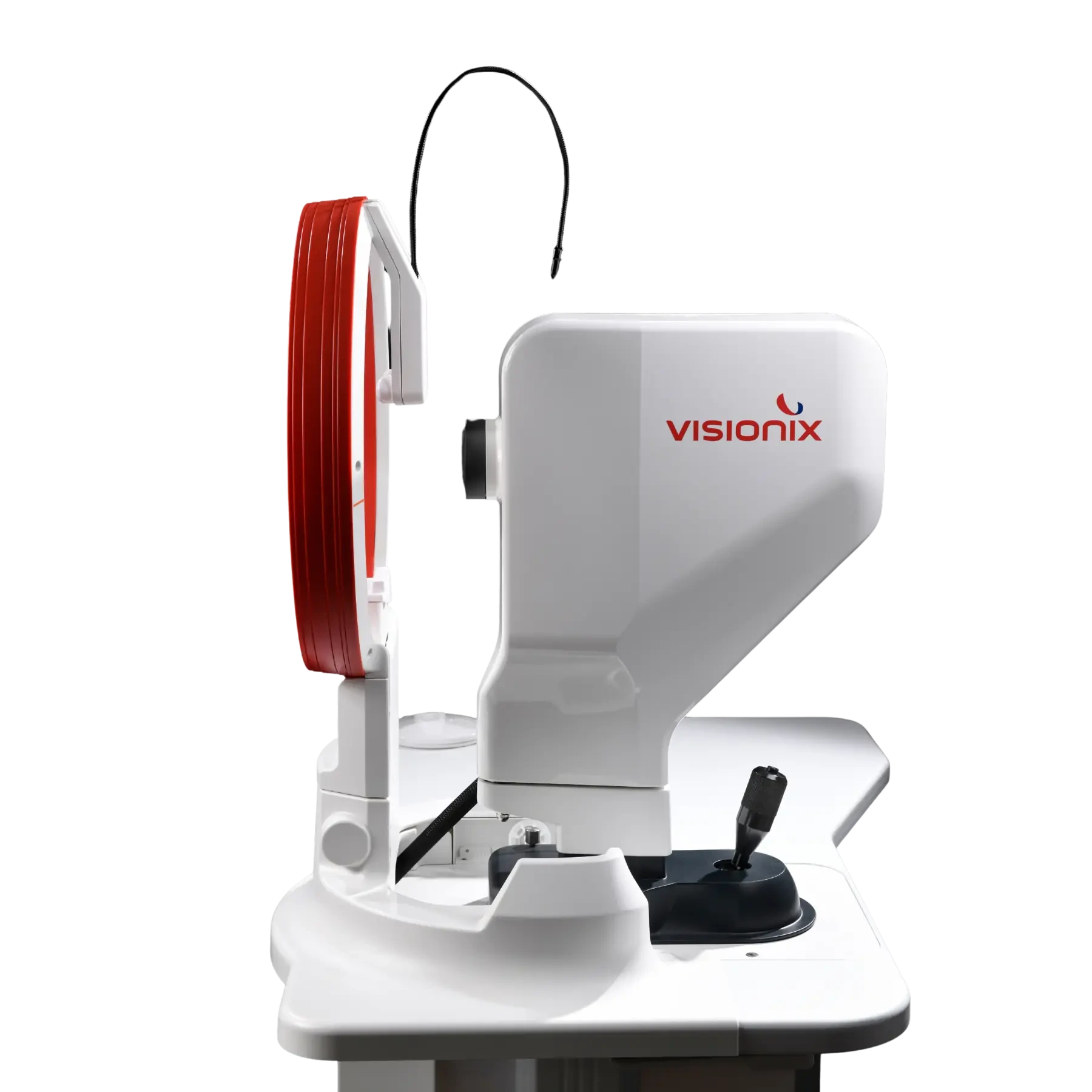
Explore Optovue SOLIX Essential
See the equipment and manufacturer examples up close. Select an image to enlarge it, then bring your workflow questions to a demonstration.
SOLIX Essential retinal OCT comparison
Structural OCT example published on the SOLIX Essential page. Compare the B-scans and segmentation during a demonstration. Image courtesy of Adil El Maftouhi, Centre Rabelais, Lyon, France; published by Visionix.
SOLIX Essential AngioVue vascular example
An en face OCT-A example published by Visionix for SOLIX Essential. Confirm AngioVue licensing and scan protocols for your configuration. Image courtesy of Adil El Maftouhi, Centre Rabelais, Lyon, France; published by Visionix.
SOLIX Essential structural and vascular views
Visionix shares this structural/OCT-A illustration across the SOLIX family. It illustrates AngioVue output, not FullRange capability on Essential. Image courtesy of Adil El Maftouhi, Centre Rabelais, Lyon, France; published by Visionix.
Resources to explore
Key capabilities
120 kHz spectral domain OCT, the same engine as SOLIX
AngioVue single scan producing structural and vascular OCT together
AngioVue OCT-A with enhanced metrics
iWellness scan for routine comprehensive assessment
Multi-volume averaging SSADA and 3D PAR 2.0
DualTrac Motion Correction Technology
Advanced scan patterns in the Optovue software
Corneal scans including pachymetry, angle measurement and 3D imaging
10 mm Corneal Layer Map across 16 meridians quantifying epithelial, stromal and total corneal thickness
Change Analysis report comparing corneal thickness between visits
Imaging from the cornea to the choroid
What is shared, and what is added on the full SOLIX
Shared across both: the 120 kHz engine, 5 micron axial and 15 micron transverse resolution, iWellness, AngioVue single scan, AngioVue OCT-A with enhanced metrics, multi-volume averaging SSADA, 3D PAR 2.0, and DualTrac motion correction. Anterior segment imaging is also present on Essential, including pachymetry, angle measurement, 3D imaging and the 10 mm Corneal Layer Map.
- FullRange retinal imaging, the 16 x 6.25 mm posterior scan
- FullRange anterior imaging, the 18 x 6.25 mm scan covering the whole anterior chamber or crystalline lens in one pass
- Longer scan range in a single acquisition
- Integrated fundus photography
- External IR imaging
Deciding between the two
This is a question about scan range and multimodality, not about whether you can do corneal work. Look at your last few months of imaging. If you are running into scan depth limits, on high myopes or when you want the entire anterior chamber in one capture, or you want fundus photography on the same instrument, the fully featured SOLIX is the one to price. If your corneal and retinal work fits comfortably within the standard scan range, Essential gives you the same engine and software for less scope. We will walk through both against your actual case mix.
Who this is a good fit for
If none of these describe your practice, it is probably not the right instrument, and we will tell you that.
Practices adding OCT-A for the first time without needing FullRange scan range
Offices that want full corneal and epithelial mapping without the multimodal additions
Practices that want the SOLIX engine, image quality and software at a narrower configuration
Second-lane or satellite locations alongside a fully featured SOLIX
What to ask on a demo
A demo is worth more when you arrive with your own cases and a list of questions. Here is what we would raise.
- Review your recent imaging mix to see whether FullRange scan range would change anything
- Compare the two configurations side by side before pricing either
- Run a corneal layer map and confirm it covers your contact lens and ocular surface work
- Confirm which scan patterns your protocols depend on
- Discuss EMR integration and image storage
How Blue River Medical supports the Optovue SOLIX Essential
Equipment consultation and model selection
On-site or in-office demo
Installation coordination
Staff training
Workflow planning around your existing lane
Ongoing customer support and service coordination
Trade-in discussions when you are replacing equipment
We serve eye care practices in Colorado, Utah, Wyoming, and southern Idaho. Service and repair responsibility differs by manufacturer and model, so ask us what we handle directly and what we coordinate with the manufacturer. See service and maintenance for our general equipment service capabilities.
Other Visionix and Optovue systems
Optovue
Optovue SOLIX
FullRange spectral domain OCT and OCT-A with a 120 kHz scan speed, integrated fundus camera, and AngioVue angiography.
Learn moreOptovue
Optovue iVue 80
Compact 80 kHz spectral domain OCT with slit-lamp style operation, covering retina, optic disc, and cornea from one technician-friendly console.
Learn moreOptovue
Optovue iFusion 80
The iVue 80 OCT combined with the 12 megapixel iCam 12 fundus camera in one space-saving imaging system.
Learn moreRequest Information
Ask about Optovue SOLIX Essential pricing, schedule a demo, or start a trade-in conversation. We will come back with specifics for your practice.
Prefer to call? We are here to help.
Call Us: (877) 707-5688